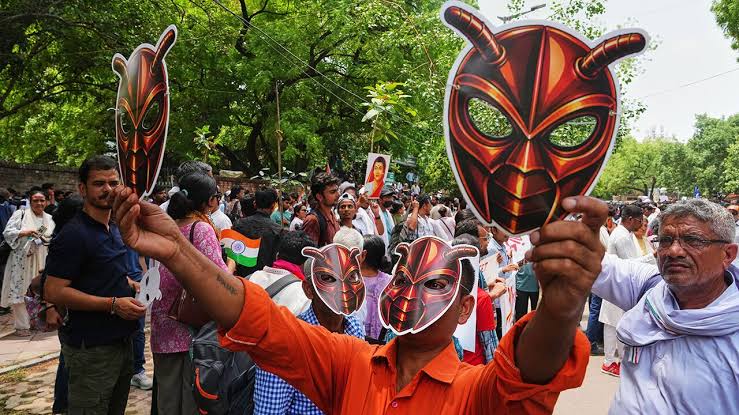
There comes a point when frustration stops being silent. There comes another point when disappointment turns into anger. And then comes the moment when young people, after years of preparation, coaching, waiting, paying fees, filling forms and sacrificing sleep, decide that they have had enough. The protests at Jantar Mantar in New Delhi have emerged from precisely such a moment.
At the centre of this growing movement is the newly formed Cockroach Janta Party (CJP), a youth-driven political movement founded by Abhijeet Dipke in June 2026. What began as a satirical response to a controversial reference to unemployed youth as “cockroaches” soon developed into a broader mobilisation around examination irregularities, alleged paper leaks, unemployment and the demand for accountability from those responsible for administering India’s education and recruitment systems. Chief Justice of India (CJI) Surya Kant courted controversy during a Supreme Court hearing when he stated, “There are youngsters like cockroaches… they don’t get any employment… some of them become media, social media, RTI activists and start attacking everyone.” He also labeled these individuals “parasites of society.” The movement has now moved from the digital space to the streets, bringing thousands of young people and supporters into the national capital. The name may sound unusual. The anger behind it is not.
The Question Is Bigger Than NEET
India’s competitive examination system is not merely an administrative arrangement. For millions of families, it is a ladder of hope. A student preparing for NEET is not simply preparing for a three-hour examination. Behind that student may be years of coaching, sleepless nights, parental sacrifices and financial hardship. A young person preparing for a government recruitment examination may have spent the best years of his or her youth waiting for an opportunity that may come only once. Over 20 NEET-UG aspirants across India have tragically lost their lives to suicide following the massive NEET 2026 paper leak scandal, subsequent exam cancellation, and overwhelming academic pressure. Protests have erupted nationwide as students, parents, and opposition leaders demand accountability, with many labeling these deaths as “systemic killings” caused by the state’s administrative failures.
When an examination is cancelled, compromised or surrounded by allegations of malpractice, the damage is therefore not limited to a question paper. It damages trust. The controversy surrounding NEET has already demonstrated how deeply examination irregularities can affect students and families. The National Testing Agency, which conducts major national examinations, has faced intense scrutiny over examination-related controversies, while the Union Education Ministry has been repeatedly called upon to explain how such failures could occur and what safeguards are being put in place. The government may contest particular allegations. Investigations may establish that some claims are true while others are not. But there is one question that cannot be avoided: Why should students be expected to trust a system when the system repeatedly gives them reasons to doubt it?
The Making of a New Political Voice
The emergence of the Cockroach Janta Party is significant precisely because it does not fit comfortably into India’s traditional political vocabulary. It was not born in the corridors of Parliament. It emerged from the frustration of young Indians who increasingly feel that conventional political language does not adequately express their anxieties. Abhijeet Dipke’s initiative began as a satirical political response but quickly acquired a wider meaning. The movement’s central concerns—examination integrity, unemployment, accountability and the future of India’s youth—are issues that cut across political affiliations. The protest has consequently attracted attention far beyond the people who initially formed it. The government should therefore be careful not to dismiss this movement merely because of its unconventional name. History repeatedly demonstrates that movements are often born in unexpected forms. What begins as satire can become dissent. What begins as dissent can become a political demand. And what begins as a demand from students can eventually become a national conversation.
Then Came Sonam Wangchuk
The arrival of Sonam Wangchuk gave the movement an additional moral and national dimension. The engineer, educator and social activist joined the protest and began an indefinite hunger strike on June 28 in solidarity with the youth movement and its demands concerning examination accountability. His presence brought national attention to a protest that had, until then, been largely driven by young people. For Wangchuk, the hunger strike was not simply a political gesture. It was a form of personal sacrifice intended to draw attention to what protesters regard as a systemic failure.
Sonam Wangchuk is a Ladakhi engineer, educator and innovator best known for founding SECMOL (Students’ Educational and Cultural Movement of Ladakh), which helped reform education in the region by making learning more practical and student-focused. He is also widely recognized for creating the “ice stupa” technique to store winter water for use in summer, and for promoting solar-powered, climate-friendly building designs in cold desert areas. In addition, he has worked on developing solar tents for the Indian Army, designed to provide portable, energy-efficient shelter in extreme high-altitude conditions. For his work in education and sustainable innovation, he has received major honours, including the Ramon Magsaysay Award in 2018.
But a hunger strike always raises a difficult question for a democratic government: Does the State respond to the demand, or does it respond only to the health emergency created by the protest? On July 18, after 21 days of fasting, Wangchuk was removed from the Jantar Mantar protest site and taken to Safdarjung Hospital as his health deteriorated. Reports said that he did not consent to being hospitalised, while authorities cited medical concerns and a Delhi High Court directive as the basis for the action. The incident immediately triggered criticism from supporters and raised questions about the balance between an individual’s right to protest and the State’s responsibility to prevent a serious medical emergency. Whatever one’s political position, the episode should concern anyone who believes in democratic dissent. A government has every right to maintain public order. It also has a responsibility to ensure that peaceful protest is not unnecessarily suppressed. The two principles are not contradictory. They are supposed to coexist in a democracy.
July 20: When the Protest Reached a New Point
The situation intensified further when protesters sought to march towards Parliament on July 20. The confrontation between protesters and the authorities became the defining image of the movement. Police action, detentions and allegations of excessive force transformed what had begun as a protest over examination irregularities into a much larger debate over the treatment of dissent itself. There have been conflicting accounts regarding the exact sequence of events and the conduct of individual police personnel. Allegations of lathi-charge, use of tear gas shells and excessive force must be investigated properly, rather than settled through competing political narratives or unverified videos circulating on social media.
But one principle should be beyond dispute: No student should be beaten merely for raising a legitimate grievance, and no police officer should be above accountability if excessive force is established. What made the images and eyewitness accounts even more disturbing, according to protesters, was the allegation that some of the people beating students were not in uniform and were not clearly identifiable as police personnel. Several students were reportedly seen with head injuries, and female students alleged that they were manhandled during the scuffle. These claims, would raise serious questions not only about crowd control but also about the use of plain-clothes personnel in a protest situation.
When Opposition Politics Enters the Scene
As the protest grew, political leaders from opposition parties also joined the debate and expressed support for the protesters. The issue was raised by opposition voices in Parliament, with demands for the government to address concerns surrounding examination integrity and police action. This is inevitable in a democracy. When thousands of young people gather in the capital, political parties will respond. But the larger issue should not be reduced to whether the Congress supports the protest, whether the Samajwadi Party supports it, or whether other opposition leaders stand with the students. The students are not merely an opposition vote bank.
They are citizens. Their concerns should matter even when no political party is standing behind them. If Rahul Gandhi, Chandrashekhar Azad or leaders of other political parties raise their voice on behalf of protesting students, the government should answer the substantive questions rather than dismissing the entire movement as political mobilisation. Equally, opposition parties must resist the temptation to use students merely as instruments of political confrontation. The future of India’s youth is too serious to become another battlefield in the routine politics of Delhi.
Is India Experiencing a Revolution?
This is the question that now hangs over the protests, the slogans, the hunger strike and the anger of the young. If by revolution one means the sudden overthrow of the State, then no—India is not witnessing a revolution in that classical sense. The institutions remain in place, elections continue, courts function, governments govern and the constitutional order still stands. But if by revolution one means a deep and irreversible shift in political consciousness, then the answer becomes more complicated. India may well be witnessing the early signs of a generational revolution. It is not a revolution of guns or barricades. It is a revolution of expectations. Young Indians are no longer willing to accept silence, delay and vague assurances as the price of participation in public life. They are demanding transparency from institutions, dignity from the State and fairness from systems that decide their futures.
This is a revolution in the language of citizenship. It is also a revolution in the way protest is organised. Social media, satire, digital mobilisation and youth-led collectives are now shaping public debate in ways that older political structures often struggle to understand. The Cockroach Janta Party may have begun as a joke to some, but it has exposed a serious truth: a generation that feels mocked by power will eventually learn to mock power back. That does not mean India is on the verge of upheaval. It does mean that the old relationship between the governed and the governing is changing. And when that relationship changes, history often calls it something larger than protest. It calls it a turning point.
The Ministry of Education Must Answer
The Union Education Ministry under Mr. Darmendra Pradhan cannot escape scrutiny simply by saying that investigations are underway. Investigations are necessary. But accountability is larger than investigation. Who is responsible when an examination system fails? Who monitors the agencies conducting these examinations? Who protects the confidentiality of question papers? Who ensures that students who have done nothing wrong do not pay the price for the failures of others? And, most importantly, what structural reforms are being implemented so that the same crisis does not return next year under another name? These are reasonable questions. The government has the right to reject allegations that are not supported by evidence. But it does not have the luxury of ignoring the anxiety of millions of students.
A government is not accountable only when a court finds it guilty of wrongdoing. It is also accountable when public institutions lose the confidence of the people they serve. The Ministry of Education must therefore communicate more clearly, more transparently and more consistently. Silence, whenever it is perceived as silence, creates a vacuum. And in that vacuum, rumours grow, distrust deepens and every new allegation becomes more explosive than the last.
The Paper-Leak Problem Cannot Be Treated as an Isolated Incident
India has witnessed repeated controversies involving competitive and recruitment examinations over the years. NEET is only the most visible example in the current national debate. The larger problem concerns the vulnerability of examination systems to leaks, impersonation, cheating networks, organised malpractice and administrative failures. The UGC NET June 2026 Sociology exam is under scrutiny for alleged paper leaks. A confidential 100-page PDF allegedly matching the exam questions circulated on social media before the June 30 test. The National Testing Agency (NTA) delayed the answer key while investigating these claims. Every such episode creates a chain reaction. An examination is cancelled. Students prepare again. Families spend more money. Coaching cycles begin again. Admissions are delayed. Recruitment is postponed. The age of candidates advances. And for some students, the opportunity disappears forever. The people who suffer most are rarely those who engineered the malpractice. They are the honest students. The student who studied honestly does not get his or her year back. No compensation can fully restore a lost year of youth. No re-examination can return the emotional stability lost by a student who has already endured months or years of uncertainty. This is why examination integrity should be treated as a matter of national security of a different kind—the security of India’s human capital.
The Real Victim Is the Student Who Still Believes
There is something deeply tragic about the young Indian student today. The student is told to study hard. The student does. The student is told to compete. The student competes. The student is told that merit will be rewarded. The student believes. And then, suddenly, the student hears that the examination may have been compromised. That student is asked to prepare again. The student does that too. But how many times can a young person be asked to restart life? This is the question that governments, political parties and institutions must answer. The rise of the Cockroach Janta Party, the hunger strike of Sonam Wangchuk and the protests at Jantar Mantar should therefore not be viewed merely through the narrow lens of partisan politics. They are symptoms of a deeper unease. Young Indians are asking whether the systems that decide their futures are trustworthy. That is not an unreasonable question.
A Democracy Must Listen Before It Is Forced to Hear
The government may disagree with the protesters. It may reject some of their allegations. It may point to investigations, court proceedings or administrative reforms. But the answer to public anger cannot always be barricades. Nor can it be silence. And certainly, it cannot be the belief that young people will eventually become tired and go home. They may go home. But their doubts will remain. The most important lesson from the events at Jantar Mantar is not about the Cockroach Janta Party. It is not even about one protest or one hunger strike. It is about trust. A nation cannot build its future on an examination system that its young people do not trust. Nor can it ask an entire generation to remain silent when years of hard work appear vulnerable to leaks, malpractice or administrative failure. The government must therefore do more than defend itself. It must listen. It must investigate. It must publish the facts. It must fix the system. And where failures are established, it must hold those responsible accountable—regardless of how high or low they stand. Because when an examination paper leaks, it is not merely paper that escapes into the wrong hands. It is the faith of a student that leaks away. And once that faith is lost, rebuilding it may be far more difficult than conducting another examination.